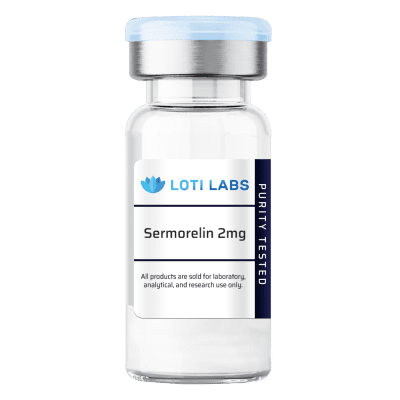
Sermorelin 2mg
Sermorelin is a synthetic 29-amino-acid peptide corresponding to the biologically active N-terminal fragment of endogenous growth hormone-releasing hormone (GHRH 1-29). Researchers have studied it in preclinical models for its ability to stimulate pituitary somatotroph cells and modulate growth hormone secretion. Supplied as a lyophilised powder for laboratory research use only.
⚠️ Disclaimer: THIS PRODUCT, SOLD BY LOTI LABS, IS INTENDED AS A RESEARCH CHEMICAL ONLY.
This designation allows the use of this chemical strictly for in-vitro laboratory testing and experimentation. No other uses or purposes are permitted. All information provided on this website is for educational purposes and has been compiled from multiple sources believed to be accurate. Human or animal use of this product is strictly forbidden by law. This product is not a drug, food or cosmetic and may not be misbranded, mislabeled or misused as such. Anyone not adhering to these terms will be blacklisted and forbidden from purchasing.
For more information on the naming of this product CLICK HERE
Sermorelin 2mg — Research Overview
Sermorelin (GHRH 1–29 NH₂) is the biologically active N-terminal fragment of endogenous growth hormone releasing hormone (GHRH). It’s made up of the first 29 amino acids of the native 44-residue peptide. Even though it contains less than two-thirds of the full sequence, this truncated form still keeps its full biological activity at the GHRH receptor. That’s enough to trigger growth hormone synthesis and secretion from pituitary somatotrophs. Because it’s smaller than full-length GHRH or synthetic analogues like Tesamorelin 2mg, it’s become a go-to research tool for investigating the structural requirements of GHRHR binding.
Mechanism of Action
Sermorelin binds directly to the GHRH receptor on pituitary somatotroph cells, which kicks off adenylyl cyclase activation via a Gs protein-coupled mechanism. This process bumps up intracellular cAMP levels to activate protein kinase A, which then phosphorylates the transcription factors that control GH gene expression. It also boosts calcium influx through voltage-gated channels, with both actions leading to GH vesicle exocytosis. Since sermorelin works through the body’s native GHRH pathway, the GH release stays under the control of physiological feedback from somatostatin and circulating IGF-1. This ensures GH secretion keeps its natural, pulsatile rhythm instead of being forced into a sustained, non-physiological spike. This product is for research purposes only and is not intended for human administration; it should only be used by qualified investigators.
Because it preserves feedback regulation, sermorelin is a go-to tool for studies looking to interrogate the somatotropic axis without breaking its self-regulatory architecture. Researchers investigating age-related GH decline, pituitary reserve, or the metabolic effects of restored GH pulsatility often pick sermorelin for this exact reason. It works alongside the body’s own regulatory mechanisms instead of just bypassing them.
Research Context
Researchers have been digging into sermorelin for decades. Early studies focused on characterising its pharmacokinetics and receptor binding kinetics, comparing its GH-stimulating properties directly against full-length GHRH. Later work shifted toward models of adult-onset GH deficiency—a condition where blunted GH pulsatility is usually a core finding. Both preclinical and clinical data suggest that using a GHRH analogue to restore physiological GH pulsatility might help recover some of the somatotropic deficits linked to aging or hypothalamic dysfunction.
Researchers often compare sermorelin with Ipamorelin 2mg and Hexarelin 2mg to see how different intervention points in the GH secretory pathway change release patterns. When you combine GHRH analogues like sermorelin with GH secretagogues like ipamorelin, it consistently triggers synergistic GH release in animal models. This happens because the two compounds work on complementary receptor systems within the somatotroph. In these types of experiments, the CJC-1295 W/O DAC analogue is frequently used as a longer-acting GHRH comparator.
Researchers have also looked into how sermorelin might affect sleep architecture, especially since there’s such a clear link between slow-wave sleep and GH secretory bursts. Whether sermorelin actually boosts these GH-associated sleep stages remains a key focus in current sleep research models.
Laboratory Handling
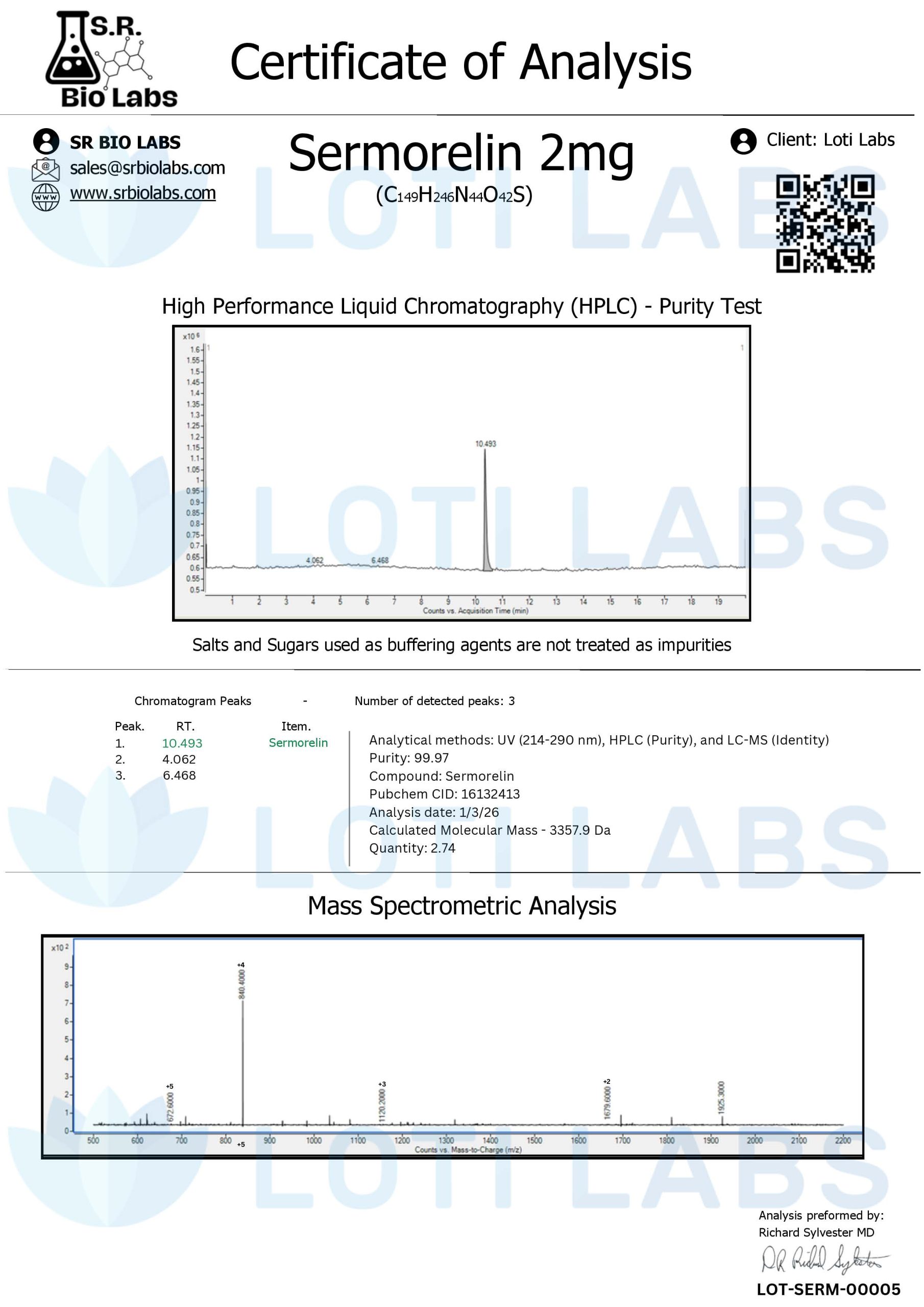
Sermorelin 2mg comes as a lyophilised powder. When preparing for research, the investigator typically reconstitutes it with sterile bacteriostatic water. Once in solution, it remains stable at 4°C for short-term use, but research teams should store it at −20°C if long-term preservation is required. The solution must not be left at room temperature for extended periods, as peptide degradation can occur rapidly. It is advisable for labs to use HPLC to verify purity before commencing in vivo experiments, particularly for dose-response studies where accurate characterisation of peptide activity is essential.
This product is for research and laboratory use only. It’s not for human administration or clinical applications.
References
- Thorner MO, et al. Sermorelin: a valuable tool for understanding and reversing the somatopause. Horm Res. 1997;48 Suppl 6:30–37.
- Prakash A, Goa KL. Sermorelin: a review of its use in the diagnosis and treatment of children with idiopathic growth hormone deficiency. 1999;12(2):139–157.
- Corpas E, et al. Human growth hormone and human aging. Endocr Rev. 1993;14(1):20–39.
- Alba M, Salvatori R. Dynamics of pulsatile growth hormone secretion in patients with multiple pituitary hormone deficiencies due to GHRH receptor mutations. Clin Endocrinol (Oxf). 2005;63(5):514–519.
For more information on Sermorelin peptide please visit Pubmed.
| Weight |
0.0099 lbs |
| Appearance |
Fine White Lyophilized Powder |
| Residue Sequence |
H-Tyr-Ala-Asp-Ala-Ile-Phe-Thr-Asn-Ser-Tyr-Arg-Lys-Val-Leu-Gly-Gln-Leu-Ser-Ala-Arg-Lys-Leu-Leu-Gln-Asp-Ile-Met-Ser-Arg-NH2 |
| Solubility |
100 µg/mL sterile diluent (distilled de-ionized water) |
| Source |
Biosynthetic production |
| Stability |
Lyophilized protein is to be stored at -20°C.
It is recommended to divide the remaining reconstituted peptide into multiple vials
so as to avoid a cycle of freezing and thawing. Reconstituted protein can be stored at 4°C. |
| Molar Mass |
3357.96 g/mol |
| CAS Number |
86168-78-7 |
| PubChem |
CID 16133753 |
| Molecular Formula |
C149H246N44OS42S |
| MG |
2mg |
| Terms |
This product is sold for research/laboratory usage only. No other uses are permitted. |