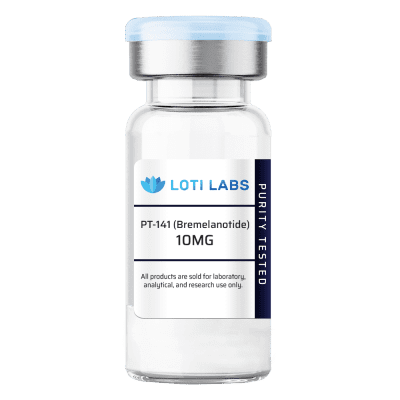
PT-141 (Bremelanotide) 10MG
PT-141 (Bremelanotide) is a synthetic melanocortin receptor agonist derived from Melanotan II. It has been studied in preclinical models for its interactions with MC3R and MC4R receptors, with research focusing on CNS-mediated signalling pathways related to autonomic and neuroendocrine function. Supplied as a lyophilised powder for qualified laboratory research use only.
⚠️ Disclaimer: THIS PRODUCT, SOLD BY LOTI LABS, IS INTENDED AS A RESEARCH CHEMICAL ONLY.
This designation allows the use of this chemical strictly for in-vitro laboratory testing and experimentation. No other uses or purposes are permitted. All information provided on this website is for educational purposes and has been compiled from multiple sources believed to be accurate. Human or animal use of this product is strictly forbidden by law. This product is not a drug, food or cosmetic and may not be misbranded, mislabeled or misused as such. Anyone not adhering to these terms will be blacklisted and forbidden from purchasing.
For more information on the naming of this product CLICK HERE
PT-141 (Bremelanotide) 10mg — Research Overview
PT-141, often referred to by its INN name bremelanotide, is a cyclic heptapeptide that originates from the synthetic melanocortin analogue Melanotan II. It’s different from its precursor because it lacks the specific acetyl group responsible for heavy melanocyte-stimulating activity. This change gives it a more selective profile, focusing its effects on central melanocortin receptor activation instead of peripheral skin pigmentation. Because of this selectivity, PT-141 has become a staple in melanocortin pharmacology research, especially when investigators are looking at models for sexual arousal, motivation, and how appetite is regulated.
Mechanism of Action
PT-141 acts as an agonist at melanocortin receptors, specifically MC1R, MC3R, and MC4R. Researchers are especially interested in MC4R because it’s densely expressed in limbic brain regions linked to sexual motivation, reward circuitry, and energy homeostasis. While phosphodiesterase-5 inhibitors rely on peripheral vascular mechanisms, PT-141 seems to work centrally by modulating dopaminergic and serotonergic pathways within hypothalamic and mesolimbic circuits. Preclinical evidence also suggests that activating oxytocin neurons in the paraventricular nucleus might be involved.
Researchers exploring the neurobiology of reward and motivated behaviour use PT-141 as a tool to trigger MC4R signalling in brain circuits without the mess of broader agonist activity. Its receptor profile is relatively defined, making it a solid choice for mechanistic studies, though you’ll need to account for off-target effects at MC1R and MC3R when planning your experimental design.
Research Context
PT-141’s research history is tied closely to Melanotan 2, its structural parent. While MT2 acts as a powerful broad-spectrum melanocortin agonist that triggers heavy tanning, researchers developed PT-141 to dial back that melanogenic activity while keeping the central MC4R effects intact. It’s been shown in rodent studies that PT-141 induces mounting and erections in male rats and boosts solicitation behaviour in females. These results paved the way for clinical trials and the eventual FDA approval of bremelanotide for treating hypoactive sexual desire disorder in premenopausal women.
Researchers are investigating MC4R’s role in energy balance to see if melanocortin agonists like PT-141 might influence food intake or body weight. Mice lacking MC4R develop severe obesity, and activating the receptor pharmacologically usually suppresses feeding. It’s complex to interpret, though, as sexual arousal and feeding-related circuits often overlap.
Researchers looking into the link between oxytocin signalling and sexual behaviour often use PT-141 with Oxytocin 2mg to see how these neurochemical systems mesh within reward and motivation circuits. It is a complex relationship; the way melanocortin and oxytocin pathways interact in the paraventricular nucleus is currently a very active area of neuroendocrinology research.
Laboratory Handling
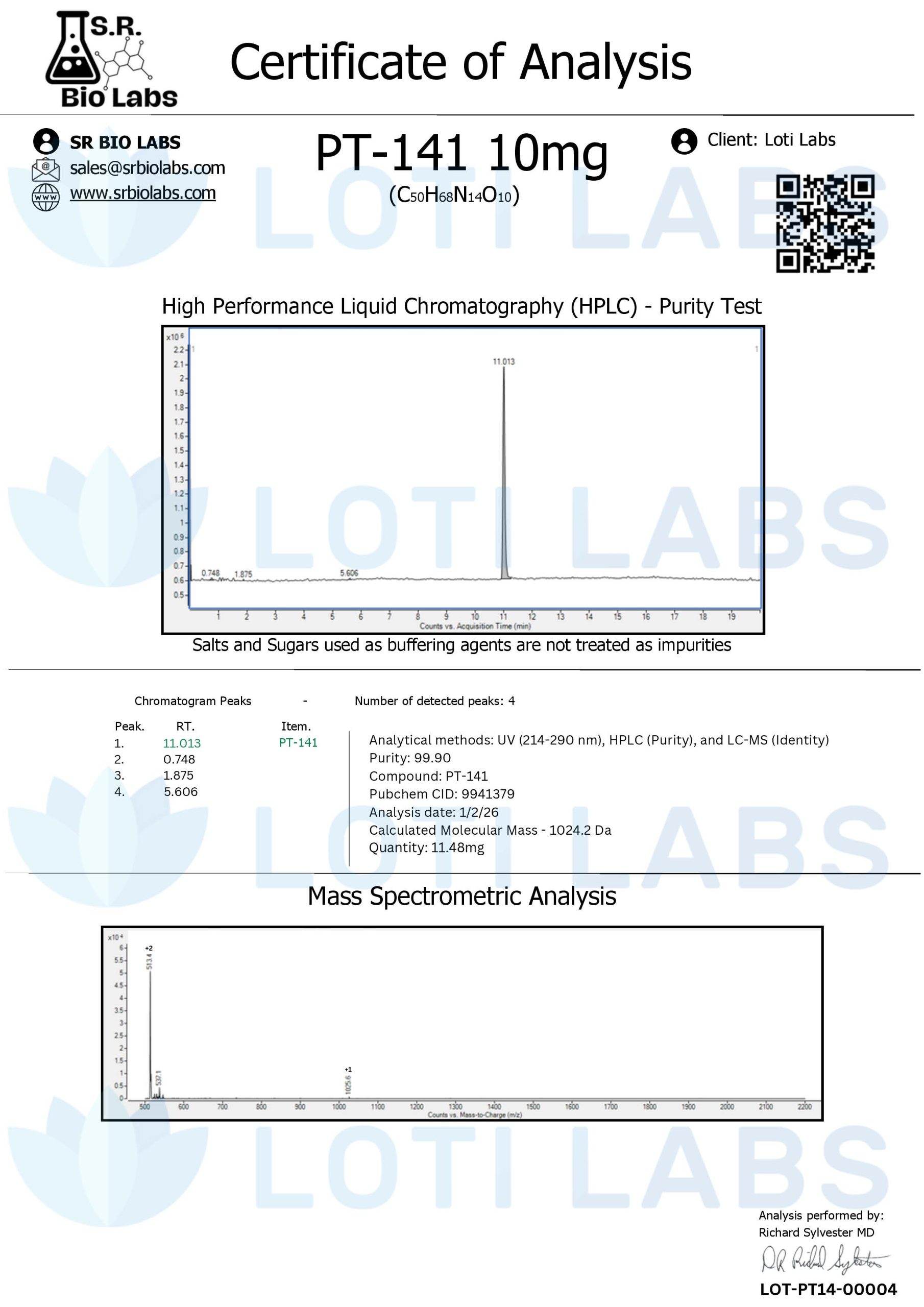
PT-141 arrives as a lyophilised powder. For research prep, investigators typically reconstitute it using sterile bacteriostatic water. It is best to aliquot the solution and keep it stored at −20°C, then use those individual aliquots quickly once they have thawed to keep the peptide’s integrity intact. This research-grade material is characterised by an HPLC purity of ≥98%. Since PT-141 has a cyclic structure, it is naturally more stable than linear peptides of a similar size, though research teams will still want to follow standard careful handling practices.
This product is intended for research purposes only. It’s not for human clinical use or administration.
References
- Safarinejad MR. Evaluation of the safety and efficacy of bremelanotide, a melanocortin receptor agonist, in female subjects with arousal disorder. J Sex Med. 2008;5(4):887–897.
- Molinoff PB, et al. PT-141: a melanocortin agonist for the treatment of sexual dysfunction. Ann N Y Acad Sci. 2003;994:96–102.
- Wikberg JE, Mutulis F. Targeting melanocortin receptors: an approach to treat weight disorders and sexual dysfunction. Nat Rev Drug Discov. 2008;7(4):307–323.
- Ückert S, et al. Effects of various nitric oxide-donating agents, an MC4R agonist, and PT-141 on rat penile smooth muscle. Urol Int. 2011;86(3):357–362.
Comparative Notes
When researching PT-141, the method of administration is a key practical factor. Early work focused on subcutaneous injections, though intranasal delivery has been studied too, showing decent CNS penetrance. The pharmacokinetic gaps between these methods—like onset, peak, and plasma level duration—are critical for timing behavioural experiments. Research teams must ensure the window of maximal receptor occupancy aligns with their measurements. It is best to characterise the pharmacokinetics under specific laboratory conditions before drawing mechanistic conclusions from any behavioural outcomes.
For more information on PT-141 Bremelanotide peptide please visit Wikipedia
| Weight |
0.0099 lbs |
| Appearance |
Fine White Lyophilized Powder |
| Residue Sequence |
Ac-Nle-cyclo[Asp-His-D-Phe-Arg-Trp-Lys]-OH |
| Solubility |
100 µg/mL sterile diluent (distilled de-ionized water) |
| Source |
Biosynthetic production |
| Stability |
Lyophilized protein is to be stored at -20°C.
It is recommended to divide the remaining reconstituted peptide into multiple vials
so as to avoid a cycle of freezing and thawing. Reconstituted protein can be stored at 4°C. |
| Molar Mass |
1025.2 g/mol |
| CAS Number |
189691-06-3 |
| PubChem |
CID 9941379 |
| Molecular Formula |
C50H68N14O10 |
| MG |
10mg |
| Terms |
This product is sold for research/laboratory usage only. No other uses are permitted. |