Epitalon 10mg — Research Overview
Epitalon (Epithalon; Ala-Glu-Asp-Gly) is a synthetic tetrapeptide analogue of epithalamin, a polypeptide extract from the pineal gland. It was first isolated and characterised by Vladimir Khavinson and his team at the St. Petersburg Institute of Bioregulation and Gerontology in Russia during the 1980s and 1990s. While most research peptides work through specific receptor systems, epitalon’s mechanism seems to focus on epigenetic regulation. Specifically, it’s thought to activate telomerase (hTERT), which is the enzyme that maintains telomere length. Most of the peer-reviewed research on this peptide comes from the original Russian group that developed it. Because of this, independent replication remains a key factor for qualified investigators evaluating the current evidence base. This product is for research purposes only and is not intended for human administration.
Mechanism of Action
Epitalon’s most cited mechanism involves stimulating telomerase activity in somatic cells, which might slow down telomere shortening and extend a cell’s replicative lifespan. In vitro studies led by Khavinson found that epitalon increased telomere length in human fetal fibroblasts and retinal epithelial cells, leading to better cell division capacity. Researchers believe the signalling pathway works through transcriptional upregulation of the hTERT gene—the catalytic subunit of telomerase. However, we don’t yet have a definitive characterisation of the upstream receptor or epigenetic mechanism that actually triggers this transcriptional effect.
Epitalon’s also been linked to melatonin regulation in various animal studies. Preclinical data suggests it might stimulate melatonin synthesis within pinealocytes, potentially restoring levels that naturally decline with age and modulating genes tied to circadian rhythms. If this pineal-modulating activity is confirmed, it’d connect epitalon to circadian biology, sleep quality, and melatonin’s downstream antioxidant effects—three research areas that are central to the biology of ageing.
Research Context
The bulk of preclinical evidence for epitalon stems from Russian research programmes looking at aging animal models. Studies in mice and rats reported longer lifespans, fewer spontaneous tumours, better immune function, and preserved retinal structures compared to controls. While these findings are interesting, they’ve mostly come from a single research group and haven’t been widely replicated in independent Western laboratories. It is a detail researchers should keep in mind when designing studies around these outcomes.
Gerontology researchers often look at epitalon alongside other compounds linked to longevity. When investigating the biology of ageing, research programmes frequently group epitalon into multi-peptide panels to examine hallmarks like telomere dynamics, NAD+ metabolism, DNA repair, and gene expression restoration. Including NAD+ 500mg, GHK-Cu 50mg, and Pinealon 10mg — another neuropeptide Khavinson developed — alongside epitalon lets scientists compare multiple mechanisms across ageing cell and animal models. They’ll also sometimes include MOTS-c 10mg, as it is a mitochondria-derived peptide that’s relevant to metabolic and longevity pathways.
Epitalon shows real preclinical promise in retinal biology, particularly in studies involving aged rats where it helped preserve photoreceptor structure and the integrity of the retinal pigment epithelium. Researchers haven’t fully pinned down whether these effects stem from telomerase activation, melatonin modulation, or different mechanisms entirely.
Laboratory Handling
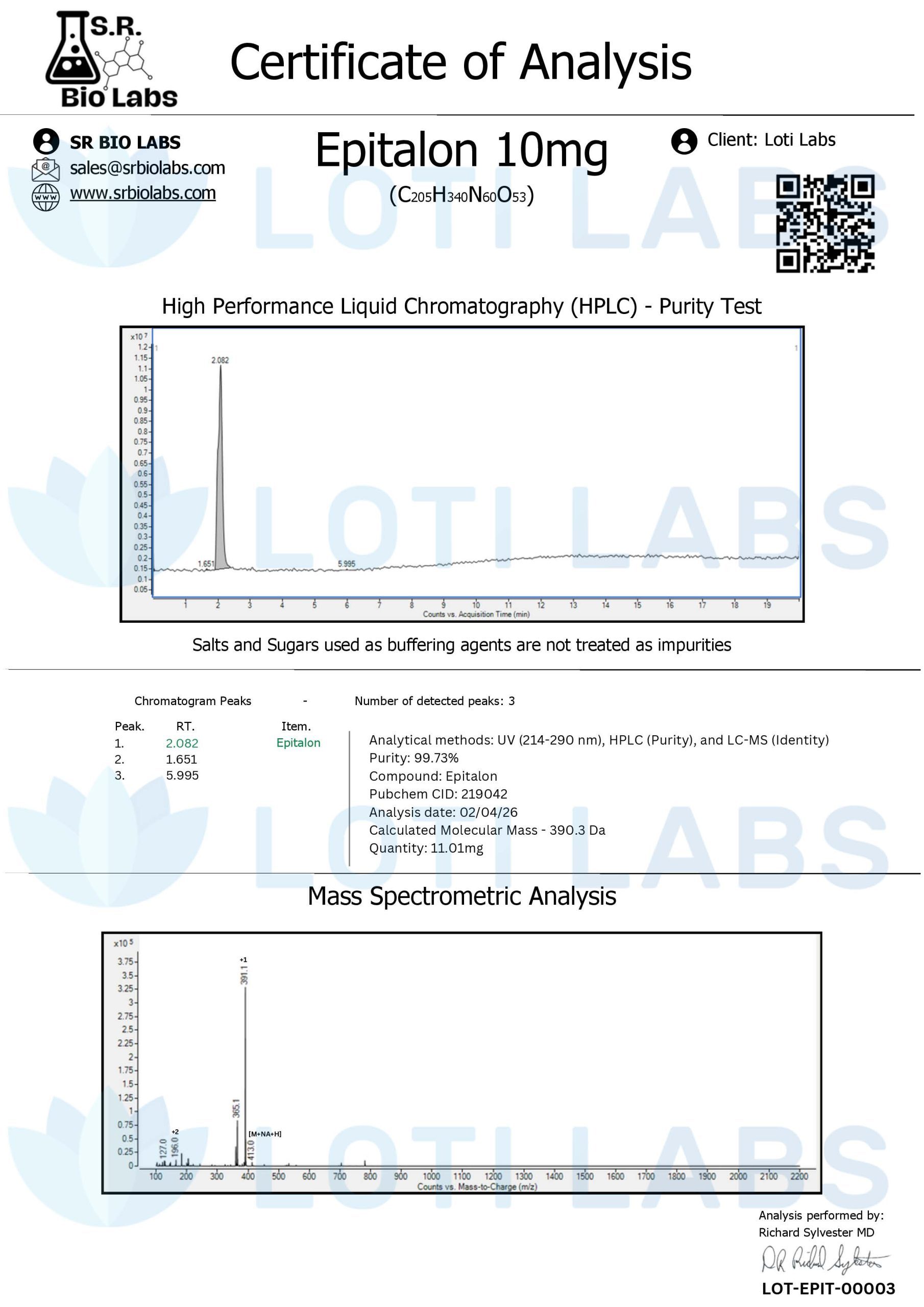
Epitalon 10mg comes as a lyophilised powder. Since it is a small tetrapeptide, it’s highly water-soluble and reconstitutes easily in sterile water or saline. Store reconstituted solutions at 4°C for short-term use or −20°C for longer storage. The lyophilised powder itself is stable at −20°C for extended periods. Purity by HPLC is typically ≥98% for this research-grade material.
For research purposes only. Not intended for clinical or therapeutic use in humans.
References
- Khavinson VK, et al. Epithalon peptide induces telomerase activity and telomere elongation in human somatic cells. Bull Exp Biol Med. 2003;135(6):590–592.
- Anisimov VN, et al. Effect of Epitalon on biomarkers of aging, life span and spontaneous tumor incidence in female Swiss-derived SHR mice. 2003;4(4):193–202.
- Khavinson VK, Morozov VG. Peptides of pineal gland and thymus prolong human life. Neuro Endocrinol Lett. 2003;24(3–4):233–240.
- Vinogradova IA, et al. Effect of Ala-Glu-Asp-Gly peptide on life span and development of spontaneous tumors in female rats exposed to different light/dark regimens. Bull Exp Biol Med. 2008;146(2):226–230.
For more information on Epitalon peptide please visit Wikipedia.
| Weight |
0.0099 lbs |
| Appearance |
Lyophilized Powder |
| Residue Sequence |
Ala-Glu-Asp-Gly |
| Solubility |
100 µg/mL sterile diluent |
| Source |
Biosynthetic production |
| Stability |
Lyophilized protein is to be stored at -20°C.
It is recommended to divide the remaining reconstituted peptide into multiple vials
so as to avoid a cycle of freezing and thawing. Reconstituted protein can be stored at 4°C. |
| Molar Mass |
390.35 g/mol |
| CAS Number |
307297-39-8 |
| PubChem |
CID 219042 |
| Molecular Formula |
C14H22N4O9 |
| MG |
10mg |
| Terms |
This product is sold for research/laboratory usage only. No other uses are permited. |