DSIP 2mg – Research Overview
Delta Sleep-Inducing Peptide, or DSIP, is a nonapeptide first isolated from rabbit cerebral venous blood back in 1974 by Marcel Monnier’s Swiss research team. That initial discovery—where dialysate from sleeping rabbits actually triggered sleep in recipient animals—kicked off decades of study into how this peptide helps regulate sleep cycles. Even fifty years later, DSIP is still a major focus for investigators, though we now know its biology is far more intricate than those early researchers first thought.
Structure and Basic Properties
DSIP is a nine-amino-acid peptide with the sequence Trp-Ala-Gly-Gly-Asp-Ala-Ser-Gly-Glu. From a biochemical perspective, it’s quite unusual because it exists naturally in both free and bound forms. Some data suggests a large portion circulates while bound to carrier proteins, which changes how we look at its pharmacokinetics and distribution. The free form crosses the blood-brain barrier easily, a standout property for any neuropeptide.
DSIP doesn’t stay in circulation for very long. Studies generally report a half-life of around 30–40 minutes, though that figure can vary depending on the bound/free ratio and the specific measurement methodology used.
Sleep Research
DSIP’s namesake function—inducing sleep—remains the main focus of current research. Scientists have spent years looking into how it affects sleep architecture, specifically its impact on delta-wave (slow-wave) sleep. This is the deep, restorative phase where the body handles physical recovery, memory consolidation, and growth hormone secretion. Published studies involving both animal models and human subjects suggest that DSIP can boost delta-wave activity while shortening the time it takes to actually fall asleep.
The mechanisms behind these sleep effects aren’t fully resolved yet. DSIP doesn’t seem to follow the usual sedative pathways. It doesn’t bind significantly to GABA-A receptors, for example, making it mechanistically different from most pharmacological sleep aids. Some studies suggest the orexin system is involved, and there’s evidence of interactions with various neurotransmitter systems, specifically serotonergic and noradrenergic pathways.
If you’re investigating sleep and circadian biology, it’s worth looking at DSIP alongside other neuropeptides that influence rest. Selank 10mg, for instance, has been researched for its anxiolytic effects and potential to modulate sleep via GABAergic pathways. This offers a mechanistically different perspective for your research compared to the direct sleep-inducing properties often associated with DSIP.
Stress Response Research
DSIP’s research potential goes far beyond just sleep, especially when looking at how the body handles stress. Preclinical data shows that DSIP can modulate the hypothalamic-pituitary-adrenal (HPA) axis, which is our central stress-response system, and it might even influence cortisol and ACTH dynamics. Researchers have found that DSIP can actually reduce stress-induced changes in animal models. This suggests the peptide might help regulate the neuroendocrine response when things get challenging.
Researchers have looked into this stress-modulating activity across various models, and the idea that DSIP might help restore homeostasis after stress—instead of just suppressing the response—is pretty interesting. The difference between adaptive and maladaptive stress responses is becoming a central focus in this field, and DSIP seems to influence the former.
If your lab focuses on neuroendocrine regulation, DSIP works well alongside research tools targeting related systems. Semax 5mg, for instance, shows clear neuroprotective and cognitive-enhancing effects via BDNF pathways. While it uses different mechanisms, both peptides help answer the bigger question of how neuropeptides manage brain function in different environments.
Antioxidant and Neuroprotective Research
Recent DSIP research has started shifting toward antioxidant biology. Preclinical studies show that DSIP can lower oxidative stress markers in both brain tissue and peripheral organs, with some evidence even pointing to mitochondrial-protective effects. While these findings are still in the early stages, they suggest DSIP’s biological reach extends much further into general cellular stress responses than we first thought.
Researchers have also looked into DSIP’s neuroprotective potential using models of ischaemic injury. Some preclinical data suggests the peptide might help reduce neuronal damage after ischaemia-reperfusion. While we don’t fully understand the exact mechanisms yet, they likely involve how the peptide handles oxidative stress and interacts with various stress-response pathways.
For researchers investigating neuroprotection via antioxidant pathways, NAD+ 500mg warrants consideration. It possesses a solid body of preclinical research focused on mitochondrial support and protecting neurons. Exploring the overlap between NAD+ and DSIP within mitochondrial biology could offer significant insights for comparative studies.
Endocrine Interactions
Researchers have looked into how DSIP interacts with several endocrine axes. There’s clear evidence of it affecting the somatotropic axis and GH secretion patterns, which makes sense given the tight link between deep sleep and growth hormone release—after all, most nocturnal GH secretion happens during slow-wave sleep. Other studies have explored DSIP’s impact on LH secretion and thyroid function, though it’s worth pointing out that these findings aren’t always consistent across the available literature.
Researchers have looked into DSIP’s potential for managing opiate withdrawal. The data’s still preliminary, but it’s shown some interesting effects on the physiological shifts that happen during the process. This line of study really points toward DSIP’s wider impact on stress and homeostasis, rather than just focusing on sleep.
For researchers investigating related endocrine pathways, Pinealon 10mg is a tripeptide that has been well-documented for its effects on pineal gland function and circadian regulation. It offers a valuable complementary angle for studying the neuroendocrine control of sleep and circadian timing.
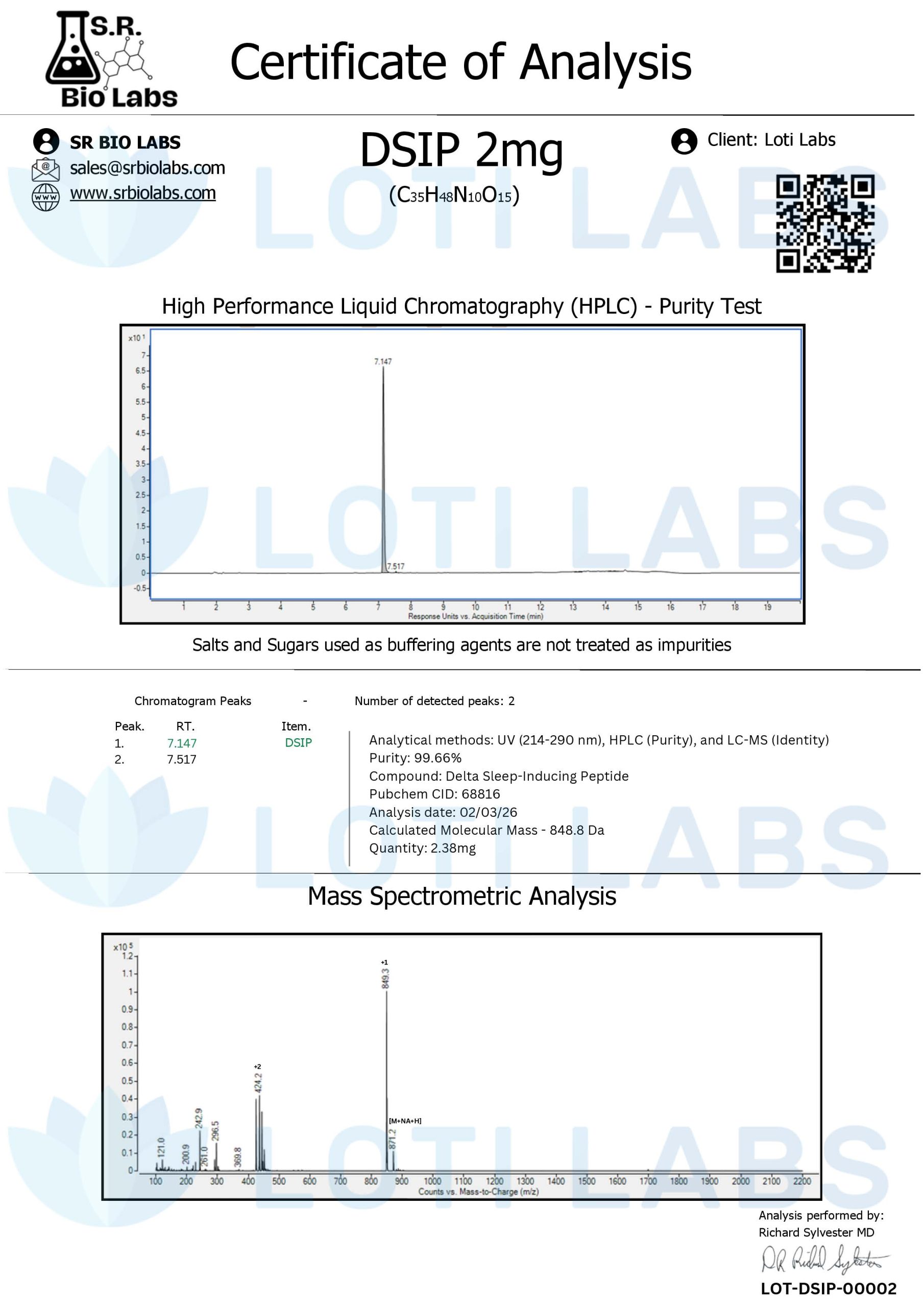
We supply this in a lyophilised form for research purposes only.
References
- Monnier M, Halberg F, Reinberg A. (1977). Slow wave sleep in the rabbit induced by dialysate from the blood of sleep-deprived dogs. Pflugers Archiv, 371(2), 203–208. PMID: 561910
- Khvatova EM, et al. (2003). Delta sleep-inducing peptide (DSIP): effect on behaviour in rats under chronic stress conditions. Peptides, 24(5), 735–740. PMID: 12895683
- Yehuda S, Carasso RL. (1991). DSIP — a summary of 20 years of research. International Journal of Neuroscience, 58(1–2), 79–99. PMID: 1917014
- Sudakov SK, et al. (1995). Delta sleep-inducing peptide and its structural analogues: their antioxidant activity. Peptides, 16(7), 1227–1232. PMID: 8545247
- Graf MV, Kastin AJ. (1986). Delta-sleep-inducing peptide (DSIP): an update. Peptides, 7(6), 1165–1187. PMID: 2880810