Ipamorelin 2mg — Research Overview
Ipamorelin is a pentapeptide (Aib-His-D-2-Nal-D-Phe-Lys-NH₂) that acts as a selective GHS-R1a agonist and growth hormone secretagogue (GHS). Developed back in the late 1990s, researchers engineered it to trigger GH release without significantly bumping up cortisol or prolactin levels. This specific selectivity is what makes it stand out from older secretagogues like GHRP-2 and GHRP-6, which tend to cause more noticeable non-GH hormonal shifts. Because of this clean pharmacological profile, ipamorelin has become a staple in modern research. It’s frequently used in studies focused on the somatotropic axis, metabolic regulation, and GI motility. This product is for research purposes only and is not intended for human administration; it should only be handled by qualified investigators.
Mechanism of Action
Ipamorelin binds tightly to GHS-R1a receptors in the hypothalamus and anterior pituitary. This triggers IP3-mediated calcium release and GH vesicle exocytosis from somatotroph cells. It’s different from native ghrelin because it doesn’t really cross-activate receptors on ACTH-secreting corticotrophs or prolactin-secreting lactotrophs. This keeps the GH response isolated compared to other GHS peptides. Such selectivity is useful for experiments where you need to adjust GH output without cortisol or prolactin spikes messing up the data.
GHS-R1a is also highly expressed throughout the gastrointestinal tract. Ipamorelin’s binding here influences GI motility through mechanisms that likely involve cholinergic and serotonergic pathways. This enteric activity’s been studied independently from its pituitary effects in GI motility research contexts.
Research Context
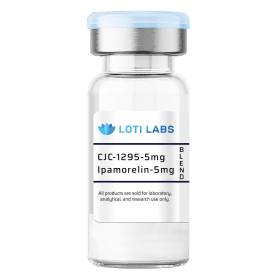
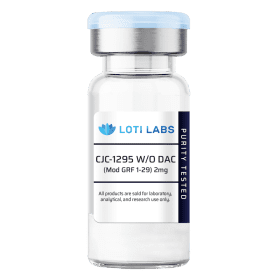
Researchers most often use ipamorelin as part of combined GHRH/GHS regimens. When you pair ipamorelin with a GHRH analogue like CJC-1295 W/O DAC 2mg or Sermorelin 2mg, it produces a synergistic GH release that’s far more substantial than what either peptide achieves on its own. This happens because of how their mechanisms complement each other; GHRH increases somatotroph cAMP and gene expression, while GHS-R1a agonism triggers calcium-dependent vesicle release. Because of this effect, the CJC-1295 / Ipamorelin Blend is a common choice in preclinical models.
Researchers often compare ipamorelin with GHRP-6 5mg, GHRP-2 5mg, and Hexarelin 2mg to map out differences in GH-stimulating potency, receptor selectivity, and hormonal co-stimulation. Out of this group, ipamorelin consistently shows the most selective GH response. This high level of specificity makes it the go-to GHS agent for study designs where avoiding off-target hormonal activity is a priority.
Researchers have used ipamorelin to study GI motility in models of postoperative ileus, where it’s shown a clear ability to speed up the return of normal bowel function in animal subjects. This effect aligns with how GHS-R1a-mediated promotion works to boost enteric neurotransmission and smooth muscle activity.
Laboratory Handling
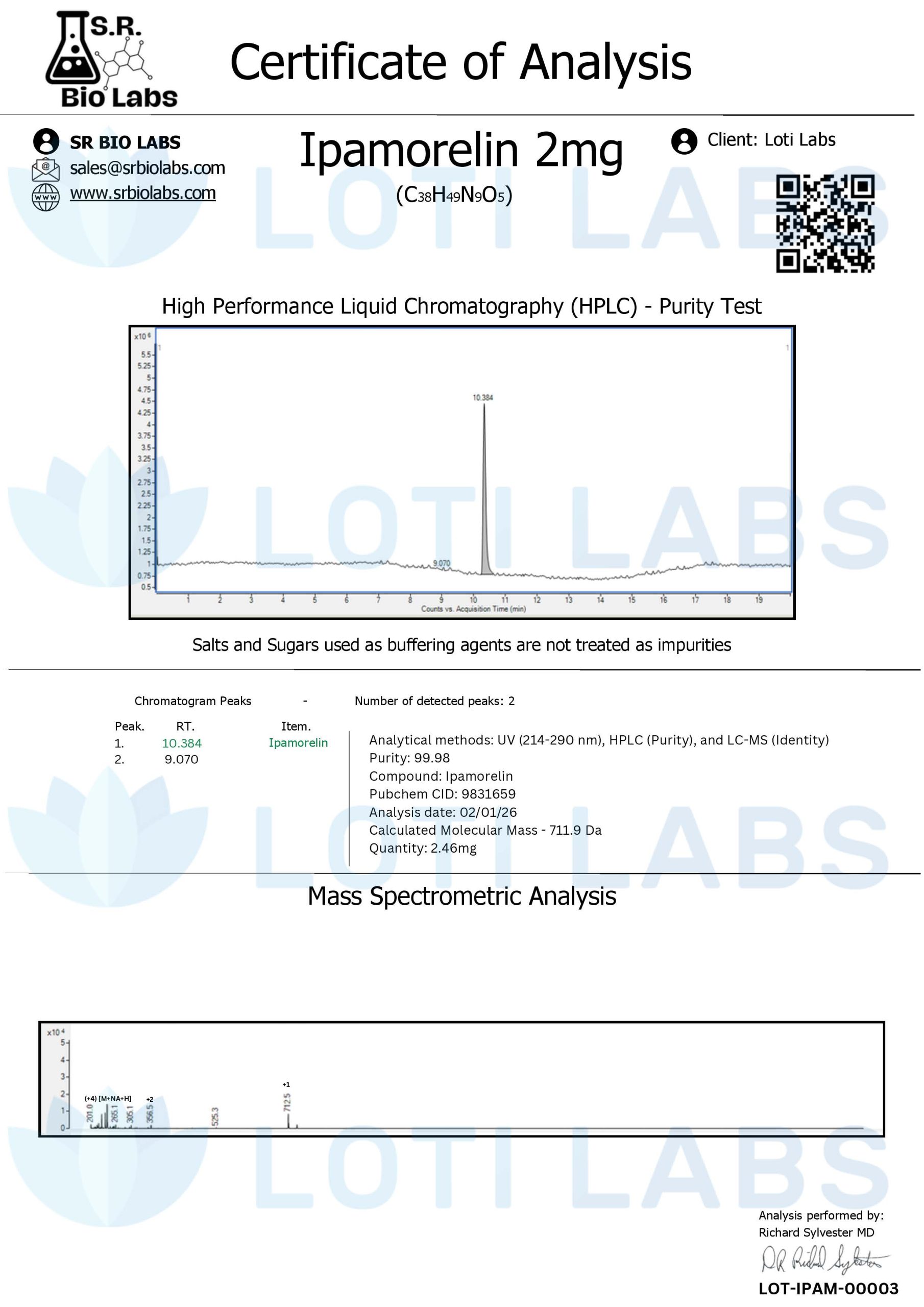
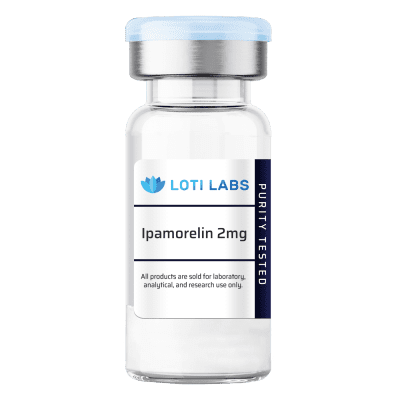
Ipamorelin 2mg comes as a lyophilised white powder. You’ll typically use sterile bacteriostatic water for reconstitution in research settings. Once it’s in solution, keep it at 4°C and use it quickly, or aliquot the liquid for storage at −20°C. Because it is a short pentapeptide, ipamorelin is fairly stable, though you should still avoid repeated freeze-thaw cycles. It is a good idea to verify the HPLC purity before you start any dose-response experiments. This product is for research purposes only and is not intended for human administration; it should only be handled by qualified investigators.
For research purposes only. It’s not for clinical or therapeutic use.
References
- Raun K, et al. Ipamorelin, the first selective growth hormone secretagogue. Eur J Endocrinol. 1998;139(5):552–561.
- Johansen PB, et al. Ipamorelin, a new growth-hormone-releasing peptide, induces longitudinal bone growth in rats. Growth Horm IGF Res. 1999;9(2):106–113.
- Beck Jensen JE, et al. Growth hormone secretagogues: implications for clinical practice. Horm Res. 1997;48 Suppl 6:9–14.
- Trudel L, et al. Ghrelin/motilin-related peptide is a potent prokinetic agent in healthy human subjects. Am J Physiol Gastrointest Liver Physiol. 2002;282(4):G655–660.
Comparative Notes
In practice, ipamorelin’s half-life in vivo is quite short—lasting only a few minutes. This means GH release is transient, mirroring physiological pulsatile dynamics when it is used at the right intervals. When designing multi-dose studies, researchers must account for this rapid clearance and plan administration timing carefully around specific GH measurement windows. For studies that require sustained IGF-1 elevation over hours or days, a GHRH analogue with a longer half-life might be more appropriate than ipamorelin on its own. That said, combining both approaches consistently yields the highest GH and IGF-1 outputs in preclinical models.
For more information on Ipamorelin peptide please visit Wikipedia.
| Weight |
0.0099 lbs |
| Appearance |
Fine White Lyophilized Powder |
| Residue Sequence |
Aib-His-D-2-Nal-D-Phe-Lys-NH2 |
| Solubility |
100 µg/mL sterile diluent (distilled de-ionized water) |
| Source |
Biosynthetic production |
| Stability |
Lyophilized protein is to be stored at -20°C.
It is recommended to divide the remaining reconstituted peptide into multiple vials
so as to avoid a cycle of freezing and thawing. Reconstituted protein can be stored at 4°C. |
| Molar Mass |
711.85 g/mol |
| CAS Number |
170851-70-4 |
| PubChem |
CID 20754357 |
| Molecular Formula |
C38H49N9O5 |
| MG |
2mg |
| Terms |
This product is sold for research/laboratory usage only. No other uses are permited. |